

Carpet Area vs Built-Up Area vs Super Built-Up Area: What You Are Actually Paying For in a Flat
- 30 June 2026
- Uncategorized
When buying a home, apartment, commercial space, or investment property, one of the most confusing aspects for buyers is understanding the difference between Carpet Area, Built-Up Area, and Super Built-Up Area. Many buyers focus on the total square footage mentioned in advertisements without realizing that not all of that space is actually usable.
A builder may advertise a property as 2,000 square feet, but the actual usable space available inside the property could be significantly less. Understanding these terms is essential for comparing properties, evaluating value for money, and making informed real estate decisions.
Whether you are purchasing a residential apartment, independent house, commercial property, plotted development, or farmhouse, knowing the difference between carpet area, built-up area, and super built-up area can help you avoid confusion and ensure transparency in your property transaction.
In this guide, we will explain these concepts in detail, discuss their importance, and help you understand which area should matter most when buying property.
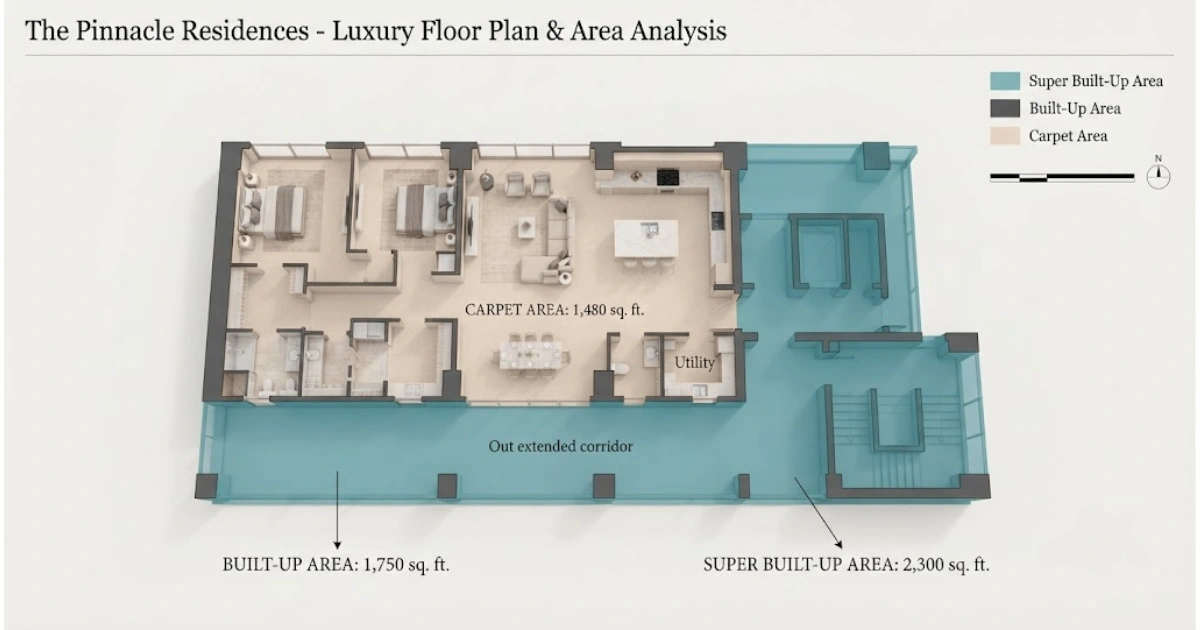
Why Understanding Property Area Matters
Property pricing is often calculated based on area measurements. However, different builders and developers may quote different types of area measurements.
Without understanding these terms, buyers may:
- Pay more than expected
- Compare properties inaccurately
- Misjudge usable living space
- Face confusion during property registration
- Make poor investment decisions
A clear understanding of property area calculations helps buyers assess the true value of a property.
What is Carpet Area?
Carpet Area refers to the actual usable floor area inside a property where you can physically place a carpet.
In simple terms, it is the area available for day-to-day living and use.
According to the Real Estate (Regulation and Development) Act (RERA), carpet area means the net usable floor area of an apartment, excluding:
- External walls
- Balcony area
- Verandah area
- Open terrace area
However, it includes the area covered by internal partition walls.
What is Included in Carpet Area?
Carpet area generally includes:
- Bedrooms
- Living room
- Dining room
- Kitchen
- Bathrooms
- Internal passages
- Study room
- Utility room within the apartment
These are spaces that homeowners actually use on a daily basis.
What is Excluded from Carpet Area?
Carpet area does not include:
- External wall thickness
- Balconies
- Verandahs
- Open terraces
- Common areas
- Lift lobby
- Staircases
- Clubhouse
- Parking spaces
Example of Carpet Area
Suppose an apartment has:
- Living room: 250 sq. ft.
- Bedrooms: 400 sq. ft.
- Kitchen: 120 sq. ft.
- Bathrooms: 80 sq. ft.
- Internal passage: 50 sq. ft.
Total Carpet Area = 900 sq. ft.
This represents the actual usable space available inside the apartment.
Importance of Carpet Area
Carpet area is considered the most important measurement for homebuyers because it reflects the actual living space available.
Benefits include:
- Accurate property comparison
- Better value assessment
- Greater transparency
- Easier space planning
- Improved buying decisions
Since RERA regulations require developers to disclose carpet area, buyers can now compare properties more effectively.
What is Built-Up Area?
Built-Up Area includes the carpet area plus the thickness of internal and external walls and other exclusive areas attached to the property.
It represents the total constructed area of the unit.
Built-up area is usually larger than carpet area because it includes portions of the structure that are not directly usable.
What is Included in Built-Up Area?
Built-up area generally includes:
- Carpet area
- Internal walls
- External walls
- Balcony
- Utility areas attached to the apartment
- Exclusive terrace (in some cases)
Formula for Built-Up Area
Built-Up Area = Carpet Area + Wall Area + Balcony Area
In most residential projects, built-up area is approximately 10% to 20% larger than carpet area.
Example of Built-Up Area
Assume:
- Carpet Area = 1,000 sq. ft.
- Wall Thickness Area = 120 sq. ft.
- Balcony Area = 80 sq. ft.
Built-Up Area = 1,200 sq. ft.
Although the apartment is marketed as 1,200 sq. ft., the usable carpet area remains only 1,000 sq. ft.
Importance of Built-Up Area
Built-up area provides a broader picture of the property's physical structure.
It helps buyers understand:
- Total construction size
- Balcony dimensions
- Wall coverage
- Structural footprint
However, built-up area should not be confused with actual usable space.
What is Super Built-Up Area?
Super Built-Up Area is the built-up area plus a proportionate share of common areas used by all residents in the building.
This is often referred to as the "saleable area" because many developers price apartments based on super built-up area.
What is Included in Super Built-Up Area?
Super built-up area includes:
Private Areas
- Carpet area
- Wall thickness
- Balconies
Common Areas
- Staircases
- Lift shafts
- Lift lobby
- Corridors
- Reception area
- Clubhouse
- Community hall
- Gymnasium
- Swimming pool access area
- Security room
- Common utility spaces
Formula for Super Built-Up Area
Super Built-Up Area = Built-Up Area + Proportionate Share of Common Areas
This allocation varies from project to project.
Example of Super Built-Up Area
Assume:
- Carpet Area = 1,000 sq. ft.
- Built-Up Area = 1,200 sq. ft.
- Share of Common Areas = 300 sq. ft.
Super Built-Up Area = 1,500 sq. ft.
A buyer may pay for 1,500 sq. ft. while actually using only 1,000 sq. ft. inside the apartment.
Difference Between Carpet Area, Built-Up Area, and Super Built-Up Area
| Feature | Carpet Area | Built-Up Area | Super Built-Up Area |
| Actual Usable Space | Yes | Partial | No |
| Includes Walls | No | Yes | Yes |
| Includes Balcony | No | Yes | Yes |
| Includes Common Areas | No | No | Yes |
| Used for Pricing | Sometimes | Occasionally | Commonly |
| Best for Buyers | Yes | Moderate | Limited |
The table clearly shows why carpet area is the most useful measurement for evaluating a property's usability.
Why RERA Focuses on Carpet Area
Before RERA, many builders advertised properties using super built-up area, making it difficult for buyers to understand the actual usable space.
To improve transparency, RERA mandated that developers disclose carpet area when marketing and selling properties.
Benefits of this rule include:
- Standardized measurements
- Better buyer protection
- Reduced misleading advertisements
- Increased transparency
Today, carpet area is considered the most reliable metric when comparing apartments.
Which Area Should Buyers Focus On?
The answer is simple: Carpet Area.
When evaluating a property, buyers should primarily focus on:
- Carpet area
- Price per square foot of carpet area
- Layout efficiency
- Space utilization
A property with a higher carpet area ratio often provides better value than one with a large super built-up area.
Understanding Loading Factor

The difference between carpet area and super built-up area is known as the loading factor.
Formula
Loading Factor (%) =
(Super Built-Up Area – Carpet Area) ÷ Carpet Area × 100
Example
Carpet Area = 1,000 sq. ft.
Super Built-Up Area = 1,400 sq. ft.
Loading Factor = (1,400 – 1,000) ÷ 1,000 × 100= 40%
A lower loading factor generally indicates more efficient space utilization.
Carpet Area vs Super Built-Up Area: Which Offers Better Value?
When comparing two apartments:
Apartment A
- Carpet Area: 1,000 sq. ft.
- Super Built-Up Area: 1,300 sq. ft.
Apartment B
- Carpet Area: 1,000 sq. ft.
- Super Built-Up Area: 1,500 sq. ft.
Both provide identical living space.
However, Apartment B may cost more because of a higher share of common areas.
This is why buyers should compare carpet areas rather than saleable areas.
Importance for Commercial Properties
Understanding area measurements is equally important when buying commercial properties.
Business owners should evaluate:
- Actual usable office space
- Customer movement area
- Employee workspace
- Storage requirements
Paying attention to carpet area helps maximize
Importance for Farmhouses and Independent Homes
For farmhouses and independent houses, buyers should examine:
- Carpet area of the building
- Built-up area of structures
- Total land area
In such properties, land value often plays a larger role than built-up area calculations.
Common Mistakes Buyers Make
Many buyers unknowingly make costly mistakes.
Avoid these common errors:
Focusing Only on Super Built-Up Area
Always ask for carpet area details.
Ignoring Loading Factor
Higher loading reduces actual usable space.
Comparing Properties Incorrectly
Compare carpet area rather than advertised saleable area.
Not Reviewing RERA Documents
Verify official carpet area disclosures before purchasing.
Conclusion
Understanding the difference between carpet area, built-up area, and super built-up area is essential for every property buyer. Carpet area represents the actual usable living space, built-up area includes walls and balconies, while super built-up area includes common amenities and shared spaces.
Among all three measurements, carpet area is the most important because it directly reflects the space you can actually use. When comparing properties, always focus on carpet area and assess the loading factor to determine whether you are getting good value for your investment.
Whether you are buying a residential apartment, commercial property, farmhouse, plotted development, or investment property, a clear understanding of these area calculations will help you make smarter decisions, avoid misleading marketing claims, and ensure maximum value from your real estate investment.
About us and this blog
We are a digital marketing company with a focus on helping our customers achieve great results across several key areas.
Request a free quote
We offer professional SEO services that help websites increase their organic search score drastically in order to compete for the highest rankings even when it comes to highly competitive keywords.
Subscribe to our newsletter!
More from our blog
See all posts






Recent Posts
- How to Calculate ROI on Real Estate Investment: Simple Formula, Examples & What's a Good Return in India 30 June 2026
- How to Earn Passive Income from Real Estate in India: Rental Yield, REITs & Smart Property Strategies 30 June 2026
- Carpet Area vs Built-Up Area vs Super Built-Up Area: What You Are Actually Paying For in a Flat 30 June 2026